
Raheny's Biodiversity Corridor
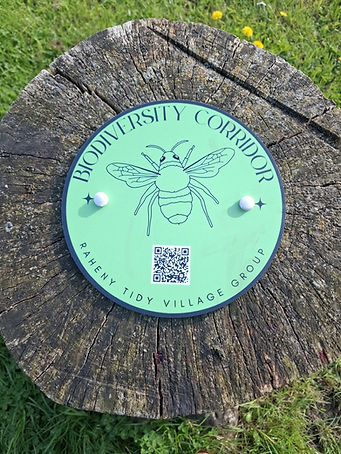
Raheny's Biodiversity Corridor is a community-led ecological network of rich flora and habitats for insects and mammals in the heart of Raheny Village. The initiative is a key action of the Raheny Biodiversity Action Plan which was launched in 2025 and developed by Raheny Tidy Village Group in collaboration with Dr. Mary Tubridy, Ecologist.
The Biodiversity Corridor extends from Hilltop, down Raheny Road through the village centre to Watermill Road, ending at the coast. This corridor includes pockets of existing biodiversity with connecting islands of added biodiversity allowing for safe migration to strengthen the local ecosystem. The corridor increases diversity, shelter, and food availability. The full route is 1.8km and can be walked in approximately 30 minutes.
Within the Biodiversity Corridor, solitary bee posts and water baths have been added to the biodiversity pockets and islands to provide crucial nesting habitats and water for bee species, such as mason and leafcutter bees. The posts have holes drilled providing a place for females to lay eggs and are positioned in areas where pollen and nectar are more readily available. The posts are beneficial for species that are facing a loss of natural habitat.
Hilltop – Capuchin Friary
The Capuchin Friary has served the community of Raheny for many generations. Historically, the surrounding lands were farmed by the religious order, and today they support a species-rich calcareous grassland. In spring, primroses and pyramidal orchids are abundant, followed by red clover and bird’s-foot trefoil in summer.
The grounds are managed with biodiversity in mind, using a reduced mowing regime from early spring through to autumn to support pollinators. During the summer months the grassland hums with life, as bumblebees and honeybees forage among the native plants, alongside hoverflies and butterflies.


Hilltop – Edenmore Park
Edenmore Park is a parkland landscape with mature trees and areas of recreational grassland. It provides valuable habitat for wildlife, including several bat species such as Soprano Pipistrelle, Common Pipistrelle and Leisler’s bat.
A wide variety of birds has been recorded here, including birds of prey such as sparrowhawks and buzzards. Bee orchids were recorded in the park in the past, and they may return with a less intensive management programme in the future. Foxes are frequent nocturnal visitors and are celebrated in the striking mural by artist Holly Pereira beside the Pitch and Putt course, painted in 2021.

Raheny Road – Pollinator Beds
A series of pollinator-friendly flowerbeds were installed along Raheny Road by Raheny Tidy Village Group, with funding from the Dublin City Council Community Climate Action Programme. These beds are planted with nectar-rich species such as perennial wallflower, verbena and salvia and are a series of islands of pollinator - friendly planting that connect the biodiversity corridor.
Spring-flowering bulbs including crocus, camassia, fritillaria and allium provide vital early food for pollinators. The bee bath at the base of the sign offers an important water source, helping insects stay cool and hydrated during warm summer weather.

Pollinator Bed Opposite Ashcroft
This pollinator-friendly flowerbed was created by Raheny Tidy Village Group to strengthen the biodiversity corridor between Raheny Road and the village centre. Planting includes perennial wallflower, mallow and other nectar-rich species. The colour scheme focuses on purples and blues, which are particularly attractive to bumblebees.
Further along just before the DART station a mural has been added to the laneway by Raheny Tidy Village Group. In conjunction with Irish Rail the mural was painted by Irish artist James Kirwan in 2023. James took inspiration from the Santry River area to depict scenes of local biodiversity. The subject matter includes a badger, heron, blue – tit and peacock butterfly and local wildflowers like pyramidal orchids, Cuckoo Pint and Leser Celandine.

Church Grounds – Angela’s Bed
This vibrant pollinator bed is lovingly maintained by a church volunteer. It features a mix of shrubs and roses alongside native wildflowers grown from seed, cuttings and plant division. Forget-me-nots self-seed freely and provide early spring colour, while annuals such as nigella and poppies create a vivid display through the summer months.
Church Grounds – Biodiversity Meadow
The grounds of Our Lady, Mother of Divine Grace Church are actively managed for biodiversity under the guidance of Raheny Tidy Village Group. The site was probably used for grazing livestock in the past and this is reflected in the natural flora of the area today. In the grounds a short flowering meadow is cut every six weeks, while the longer flowering meadow to the side and rear is cut just twice a year.
Pollinator-friendly flowerbeds flank the church, and an ivy-covered stone wall borders the rear with pyramidal orchids, bird’s foot trefoil and red clover growing in the no – mow area. A mix of native and ornamental trees has been planted over time, with a new native hedgerow added to the front of the church in 2024. Hedgerows are vital wildlife corridors, providing shelter, food and safe movement routes for many species.
Together, these varied habitats demonstrate how public spaces can support biodiversity in an urban setting. In summer, the grassland buzzes with solitary bees, bumblebees, honeybees and hoverflies. At night, Daubenton’s, Leisler’s, Common and Soprano Pipistrelle bats forage among the trees and along the nearby railway line. Foxes and up to ten bird species have also been recorded in the adjoining community garden.


Community Garden
The Community Garden is leased by Raheny Tidy Village Group from the church and is a key biodiversity hotspot. The pond provides habitat and food for insects such as damselflies and dragonflies, as well as frogs. Planting throughout the garden is a mix of wild and cultivated species.
Solitary leafcutter bees and several bumblebee species—including red-tailed, carder, white-tailed and buff-tailed bumblebees—have been recorded here. A mosaic of habitats, including wild areas, log piles, planted borders, and fruit and vegetable beds, supports a wide range of invertebrates.
Read more about about community garden here.

SuperValu – Santry River
The Santry River is one of Raheny’s most important biodiversity corridors. Riverside plants include dog violet, lords-and-ladies and lesser celandine, alongside invasive species such as winter heliotrope.
The river supports wildlife such as Daubenton’s bats, foxes, herons and mallards. The rare European eel has been recorded here on several occasions, while otters and kingfishers have been spotted along other stretches of the river. Raheny Tidy Village Group regularly monitors river health using kick-sampling and chemical analysis.

Woodland Area
This woodland is dominated by mature non-native lime trees. Raheny Tidy Village Group is working to enhance biodiversity here through targeted planting and reduced maintenance.
Spring bulbs such as crocus, bluebell and snowdrop support early pollinators, while dandelions and primroses provide vital food for queen bees emerging from hibernation. Native shrubs and pollinator-friendly perennials increase food andshelter availability. Nettles are deliberately retained to support butterfly larvae, while log piles and a bug hotel provide habitat for beetles, woodlice and spiders.
Adjacent to the woodland is a rainwater planter outside the DNG estate agent. This type of planter reduces the need for summer watering while also providing valuable forage for pollinators. It is one of a number of sustainable planters funded through a River Basin Management Service grant.

The Graveyard
Dating back to the early 18th century, the graveyard is a site of both cultural and ecological importance. The adjacent rath may even date to the Iron Age. The flora is typical of old graveyards, with mosses, ivy and wildflowers alongside planted trees and shrubs.
The site is designated as no-mow from March to the end of August, allowing long grass to support butterflies and spiders. Pyramidal orchids flourish here in early summer. Hanging baskets along the outer walls, managed by Raheny Tidy Village Group, contain at least 50% pollinator-friendly plants.

Main Street
Planters installed along Main Street by Raheny Tidy Village Group feature sustainable planting schemes combining evergreen perennials with herbaceous species. Pollinator-friendly plants such as salvia, snapdragon, erigeron and scabious are prioritised.
A rainwater planter outside Perky’s Café, funded through a River Basin Management Service grant, helps reduce summer watering while providing valuable forage for insects.
The herb planter outside Mint Cottage offers free herbs for the community and abundant nectar and pollen from rosemary, chives, thyme and sage.

Flourish
Flourish, a minimal-waste grocery store, opened in 2020 and champions locally and sustainably sourced produce. Its garden is managed for wildlife, with grass cut into pollinator islands filled with clover, ragwort, willowherb, nettle and dock.
Flourish participates in the Dispersed Orchard project run by Raheny Tidy Village Group and funded by Dublin City Council. The Santry River borders the garden, while scrub and mature trees provide habitat for blackbirds, robins, wrens, finches and squirrels.
A biodiversity mural has been added to the front of the shop, illustrating the biodiversity of the Flourish garden with native wildflowers and a dragonfly.

Manor House
Manor House Secondary School was established in 1952 on the grounds of a former Georgian manor. The grassy bank at the front of the school supports species typical of old meadow grassland. In early summer it is rich with pyramidal orchids, lady’s bedstraw, ox-eye daisy and burnet saxifrage—plants associated with calcareous and lightly grazed grasslands. Burnet saxifrage has a long history of use in traditional herbal medicine for its anti-inflammatory properties.
The school’s sensory garden includes native hedgerows, pollinator-friendly planting and water features. Wildlife commonly recorded on the grounds includes robins, blackbirds, squirrels, a family of foxes, and a heron that regularly perches on the gym roof.

Pollinator Bed – Watermill Rd
One of five new flowerbeds installed in 2025 with support from the Dublin City Council Community Climate Action Project. The pollinator beds were created to link habitats along the biodiversity corridor, providing continuous food and shelter for insects. Planting includes salvia, rudbeckia, ornamental grasses, sunflowers and snapdragons.
The crescent-shaped Coastal bed on the righthand side of the road near the bottom of Watermill Rd was created by a Raheny Tidy Village Group volunteer. It is filled with pollinator – friendly planting and includes plants that are suitable for coastal areas.

Wild Coastal Bed
Designed and planted in 2022 by Dublin City Council Parks Department, this bed showcases pollinator-friendly, low-maintenance coastal planting. Species include salvia, mallow, sea holly, verbascum and penstemon. Management is minimal, with occasional removal of brambles and goosegrass.
An adjacent stone wall covered in ivy and brambles offers year-round food and shelter for wildlife.

St Anne’s Park, Tree of Life and Bull Island
St. Anne’s park borders Watermill rd. The biodiversity in the park is a vital link between the village and the coast. The meadow and duck pond provide a range of habitats for animals such as butterflies, bees, water beetles and eels. Mallards,
Moorhens and occasionally swans inhabit the pond and the small island located at its centre. The large number of trees and scrub in the park are home to a wide range of bird and bat species.
Opposite the Wild Coastal Bed, at the end of Watermill Road, stands the Tree of Life,
a sculpture by artist Tommy Craggs (2018), celebrating the rich natural heritage of Dublin Bay.
Across the road lies the Causeway to Bull Island, a UNESCO Biosphere renowned for its unique habitats and species, including marsh fritillary butterflies, lizards and seals. The area is especially popular with birdwatchers and is a key overwintering site for the light-bellied Brent goose.